
prev

IIHE - Interuniversity Institute for High Energies (ULB-VUB)

The IIHE was created in 1972 at the initiative of the academic authorities of both the Université Libre de Bruxelles and Vrije Universiteit Brussel.
Its main topic of research is the physics of elementary particles.
The present research programme is based on the extensive use of the high energy particle accelerators and experimental facilities at CERN (Switzerland) and DESY (Germany) as well as on non-accelerator experiments at the South Pole.
The main goal of this experiments is the study of the strong, electromagnetic and weak interactions of the most elementary building blocks of matter. All these experiments are performed in the framework of large international collaborations and have led to important R&D activities and/or applications concerning particle detectors and computing and networking systems.
Research at the IIHE is mainly funded by Belgian national and regional agencies, in particular the Fonds National de la Recherche Scientifique (FNRS) en het Fonds voor Wetenschappelijk Onderzoek (FWO) and by both universities through their Research Councils.

CMS

Shown here is a result of the 2010 LHC run at the Compact Muon Solenoid,

studying the invariant mass of electron pairs produced at the Large Hadron Collider. Shown is the data, as black dots, and the simulation predicting what we should expect according to the particle physics Standard Model (colored bands). The IIHE is actively involved in the study of this kind of collisions, in collaboration with other groups of the CMS experiment. An example of what a signature due to a new particle would look like is the (simulated) gray bump. When more data is collected in 2011 we will have enough information to also study the right side of the plot and look if there are any such particles produced at the LHC. If the grey distribution would be observed, it would be a hint of the existence of, for example, extra dimensions.

CMS

Candidate top quark +W boson collision event at CERN

Shown is a candidate collision event from the 2010 LHC run that was selected in the search for one top quark associated with a W boson at the Compact Muon Solenoid experiment at CERN. IIHE scientists are leading the analysis effort in the detailed study of these kind of collisions. Understanding single top production is relevant both for the detailed understanding of the physics of top quark production but also in the context of the Standard Model Quantum Chromodynamics in general as this process is special because of the production of a single heavy quark in association with a gauge boson. This event topology is very similar to that expected for new physics or the elusive Higgs boson, for which this kind of events are a background.

IceCube/ARA

IIHE students at the South Pole

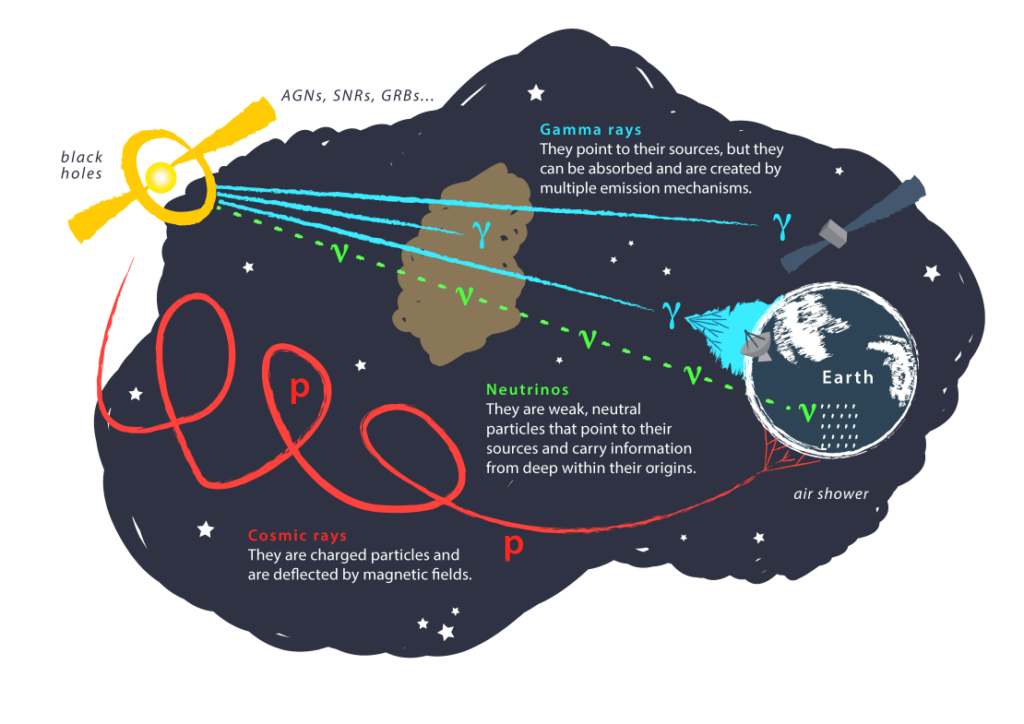
In the Antarctic Summer 2011-2012, two PhD Student from the IIHE were working at the Pole. Thomas Meures, who went down for the ARA experiment and David Heereman, working for the IceCube Observatory. Both projects are looking for Neutrinos via their interactions in the Ice. At the Inter-university Institute for High Energies (IIHE) in Brussels we are involved in a world wide effort to search for high-energy neutrinos originating from cosmic phenomena. For this we use the world's largest neutrino telescope, located at the South Pole.

CMS

Here you see the installation of the the Compact Muon Solenoid forward tracker,

which was partly built at the IIHE. The IIHE contributed to the construction of the over 200 square meter silicon tracker, the most ambitious particle tracking detector every built. Contributions were made to the assembly of detectors and their support structures, and the assembly of the detectors on a wheel such as you can see here. The tracker was installed inside the Compact Muon Solenoid detector in December 2007.

CMS

Here you see the installation of the the Compact Muon Solenoid forward tracker,

which was partly built at the IIHE. The IIHE contributed to the construction of the over 200 square meter silicon tracker, the most ambitious particle tracking detector every built. Contributions were made to the assembly of detectors and their support structures, and the assembly of the detectors on a wheel such as you can see here. The tracker was installed inside the Compact Muon Solenoid detector in December 2007.

IceCube

IIHE IceCube joining in celebration 100 years of Humans on the South Pole

IIHE IceCube joining in celebration 100 years of Humans on the South Pole At the Inter-university Institute for High Energies (IIHE) in Brussels we are involved in a world wide effort to search for high-energy neutrinos originating from cosmic phenomena. For this we use the IceCube neutrino observatory at the South Pole, the world's largest neutrino telescope which is now completed and taking data. Hundred years ago, on the 14th of December 1911, the first human being arrived on the South Pole. Roald Amundsen led the original Norwegian team that arrived, so to celebrate this Norwegian triumph, the Prime Minister of Norway came to the South Pole for 4 days to engage in the festivities.

IceCube

IIHE students at the South Pole

Falling off the earth is a serious risk at the South Pole. Down there, at the very end of the world, everything is different.. At the Inter-university Institute for High Energies (IIHE) in Brussels we are involved in a world wide effort to search for high-energy neutrinos originating from cosmic phenomena. For this we use the IceCube neutrino observatory at the South Pole, the world's largest neutrino telescope which is now completed and taking data.

CMS

The Compact Muon Solenoid forward tracker was partly built at the IIHE.

Here you see the assembly of several of the (black) support structures on which the tracker detectors were mounted. The IIHE contributed to the construction of the over 200 square meter silicon tracker, the most ambitious particle tracking detector ever built. Other contributions were made to the assembly of detector modules and the installation on the detector. Each detector element can identify the path of charged particles to a precision of up to 1/100 millimeters.

next

Copyright © 2010-2011 IIHE - Support: support-iihe@ulb.ac.be